-
 2026-09-20'Pyramide de Verlée' in Havelange, Belgium
Locals refuse to enter after sunset; they say if you stay inside past dark, you exit three days older.
source → -
 2026-09-18The Mountain House in Woodside, California
The Mountain House catches the fog in its curved eaves while whispering pines tuck you into a chilly, watchful embrace.
source → -
 2026-09-15Moaning Caverns in Vallecito, California
Strange moans echo through Moaning Caverns' deepest shafts, where the darkness itself seems to inhale and exhale with your every step.
source → -
 2026-09-13The Schnoor in Bremen, Germany
Narrow medieval alleys twist into impossible angles, where gas lamps cast long shadows that seem to move independent of their sources.
source → -
 2026-09-11Saint John Anglican Cathedral in Belize City, Belize
Behind its weathered stone walls, visitors report whispered voices echoing through empty pews at twilight, as if centuries of prayers are still searching for answers.
source → -
 2026-09-10Ten Thousand Buddhas ‘Monastery’ in Hong Kong
Ten thousand identical golden Buddhas stare blankly from every surface—a city of saints built as shrines for the dead.
source → -
 2026-09-08David Sassoon Clock Tower in Mumbai, India
Visitors report the clock ticking backwards on certain midnight hours, as if the tower is counting down to something it doesn't want to forget.
source → -
 2026-09-05The Birdhouse Tree of Riga in Rīga, Latvia
Hundreds of birdhouses crowd the ancient tree, each small doorway gazing outward—a vast, silent assembly keeping vigil over the streets below.
source → -
 2026-09-04Ahuehuete del Centenario in Monterrey, Mexico
The ancient tree's enormous shadow never fully lifts, even at noon, as if it holds something precious and refuses to let the light in.
source → -
 2026-09-03Giant Puppet Parade in Siem Reap, Cambodia
Massive puppet heads bob silently above the crowd with eyes that seem to follow you, their fixed grins suggesting they know something we don't.
source → -
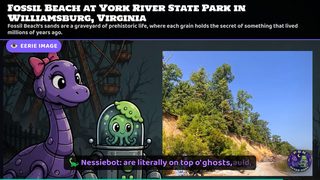 2026-08-31Fossil Beach at York River State Park in Williamsburg, Virginia
Fossil Beach's sands are a graveyard of prehistoric life, where each grain holds the secret of something that lived millions of years ago.
source → -
 2026-08-29Bunski Kanal in Malo Polje, Bosnia and Herzegovina
The water in Bunski Kanal never freezes despite winter's grip, and locals swear they hear singing beneath the ice-free surface.
source → -
 2026-08-28Doña Manolita in Madrid, Spain
Doña Manolita's lottery tickets whisper forgotten hopes; winners vanish, but their names linger on faded walls like unsold dreams waiting to be claimed.
source → -
 2026-08-26Nelson House in Yorktown, Virginia
The Nelson House's narrow staircases twist in impossible directions, as if the walls themselves remember centuries of secrets they refuse to share.
source → -
 2026-08-24Volvo Island in Ottawa, Illinois
At dusk, the island's rusted machinery whispers in unison, as if something beneath still remembers how to work.
source → -
 2026-08-21Red Sea Terminal in Marsa Alam, Egypt
Most airport terminals are designed simply to move travelers from one place to another. Terminal 1 at Hurghada International Airport attempts something more ambitious: turning the landscape outside into part of the building. Opened in late 2014, the terminal covers approximately 92,600 square meters across three main levels. Its most distinctive feature is the enormous elevated ceiling, whose flowing underside was designed to echo both the undulating Red Sea and the desert terrain surrounding Hurghada. Glass façades and wide, uncluttered interior spaces allow the ceiling to appear as though it is floating above the passengers below. The effect creates an architectural preview of the destination. Travelers arrive in the middle of an arid landscape, yet the shape of the sea is already waiting for them overhead. The terminal serves as a gateway to Hurghada and the wider Red Sea resort region, including El Gouna, Makadi Bay, Sahl Hasheesh, Soma Bay, and destinations farther south.
source → -
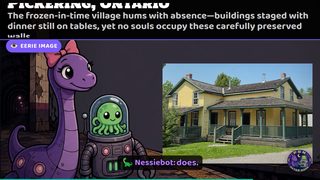 2026-08-19Pickering Museum Village in Pickering, Ontario
The frozen-in-time village hums with absence—buildings staged with dinner still on tables, yet no souls occupy these carefully preserved walls.
source → -
 2026-08-16The Bucket of Blood and St.Pialas Well in Phillack, England
St. Pialas Well drowns its secrets in Phillack's fog, while the Bucket of Blood pub watches from age-blackened stone, remembering everything.
source → -
 2026-08-15Hundafoss in Iceland
The mist at Hundafoss never clears, and those nearby swear they hear whispers in the spray—as if the waterfall itself is breathing.
source → -
 2026-08-14The Original ‘Backrooms’ Location (John’s Hobbies) in Oshkosh, Wisconsin
The back aisles of this hobby shop stretch impossibly deep, their fluorescent glow dimming as you venture toward a corner that shouldn't exist.
source → -
 2026-08-11Torthorwald Castle in Torthorwald, Scotland
Torthorwald's stones hold echoes of screams that predate language—visitors swear they hear them, though no one can say from when.
source → -
 2026-08-09Humansdorp Museum in Humansdorp, South Africa
The museum's oldest artifacts seem to shift positions overnight, and guards refuse to explain the chalk circles drawn around certain exhibits.
source → -
 2026-08-07Top Gun ‘Sleazy Bar’ in San Diego, California
Regulars swear the bathroom mirror shows their reflection exactly as they looked in 1986, no matter their actual age.
source → -
 2026-08-06Curiosity Shop in Berkeley, California
The shop's endless shelves hold items with no price tags, and collectors swear the inventory rearranges itself when no one's watching.
source → -
 2026-08-04Koolwink Motel in Romney, West Virginia
Room 12's television flickers to static at exactly 3 AM, but guests swear they see friendly faces waving from inside the snowy screen.
source → -
 2026-08-01The Living History Museum of Camping in Phelps, Wisconsin
The museum's restored campsites are frozen in perpetual dawn, with breakfast forever steaming on the tables, no matter what time you arrive.
source → -
 2026-07-31Monument to José Mata in Santa Cruz de la Palma, Spain
At midnight, locals say the bronze figure's shadow moves independently of the moonlight, as if José Mata still searches for something he lost long ago.
source → -
 2026-07-30Schwarzer Turm in Mödling, Austria
They say the tower's spiral staircase has one extra step when you descend than when you ascend.
source → -
 2026-07-27The Canal Vulva (Kutkunst) in Rotterdam, Netherlands
The canal's peculiar geometry draws and holds things at twilight—visitors never quite remember which way they entered from.
source → -
 2026-07-25Leroy's Place New Orleans in New Orleans, Louisiana
Whispers of ragtime echo through empty rooms where phantom dancers still sway to music nobody's heard for decades.
source → -
 2026-07-24White Oak Avenue in Los Angeles, California
White Oak Avenue's streetlights flicker in patterns that almost sound like morse code if you listen closely enough, spelling out names of the missing.
source → -
 2026-07-22Drops of Rain in Étretat, France
The white cliffs weep an endless rain, their stone faces watching as each drop carries whispers of those lost to the sea.
source → -
 2026-07-20Old Jail Art Center in Albany, Texas
The walls of this former jail remember every inmate who once occupied its cells, and some say they still linger between the artwork.
source → -
 2026-07-17Lai Tak Tsuen Estate in Hong Kong
At dusk, phantom footsteps echo through the identical corridors, and residents whisper that certain blocks were built on foundations of forgotten structures.
source → -
 2026-07-15The Site of Nottingham Victoria Railway Station in Nottingham, England
Phantom train whistles pierce the silence of Nottingham Victoria's abandoned platforms, where no locomotive has run since 1967.
source → -
 2026-07-12Klövasten (Cloven Stone) in Glemmingebro, Sweden
Locals whisper that the crack in the stone grows wider each full moon, as if something below keeps trying to push through.
source → -
 2026-07-10HM Prison Maze (Long Kesh) in Lisburn, Northern Ireland
These empty H-blocks whisper secrets to the shadows, playfully hiding them from curious midnight wanderers.
source → -
 2026-07-07Tomb of Dai Anga in Lahore, Pakistan
The tomb keeps its deepest secrets trapped within stone walls where footsteps echo before anyone arrives and laughter fades when you turn around.
source → -
 2026-07-05Vancouver Crow Nesting Zone in Burnaby, British Columbia
Hundreds of crows nest here in eerie synchronization—they move as one entity, their unified gaze tracking something humans can't perceive.
source → -
 2026-07-03Payson Grotto in Payson, Utah
Payson Grotto's darkness feels almost alive—locals report it's where your echo answers before you finish speaking.
source → -
 2026-07-02The Looming Head of Jānis Zvīdra in Rēzekne, Latvia
If you are driving through the town of Rēzekne in Latvia's Latgale region, keep your eyes peeled near the train station junction. Right there on a grassy corner, you’ll encounter an incredibly stoic, oversized stone head staring intensely into the distance. This is the monument to Jānis Zvīdra, and it is a textbook example of how the Soviet Union loved to turn local teenagers into monumental legends. Zvīdra was a local boy who became a passionate communist activist during the chaotic aftermath of World War I. He was caught and killed by Latvian security forces in 1920 at the tender age of 25. Decades later, in 1971, the Soviet authorities decided he was the perfect candidate for some classic propaganda glorification. They commissioned a massive gray granite bust, slapped it onto a polished black marble pillar, and turned him into a permanent hometown hero. What makes this spot wonderfully unique today isn't just the intense, "socialist-realist" look on his face—which makes him look like a very stressed comic book character wearing a flat cap—but the fact that he is still standing at all. While the Baltic states have actively cleared out almost all Soviet military monuments, Zvīdra has somehow managed to hang onto his quiet street corner, mostly because he was an ethnic local rather than a foreign general. It’s a bizarre, fascinating slice of retro political history hiding right next to a park bench, making it the perfect roadside quick-stop for anyone tracking down the remaining, subtle ghosts of the twentieth century.
source → -
 2026-06-30CVRATED by Ryan Matthew Cohn in Bridgeport, Connecticut
In CVRATED's converted industrial heart, the art doesn't just hang—it exhales, its presence heavier in the dark.
source →