-
 2026-11-26Morning Glory cloud
The Morning Glory cloud is a rare roll cloud that forms from a low-level solitary wave and can be up to 1,000 km long, often only 100 to 200 m above the ground. It travels at 10 to 20 meters per second. The southern Gulf of Carpentaria is the only known place where it can be predicted and seen regularly, and glider pilots visit Burketown from late September to early November to ride it.
source → -
 2026-11-22Flyby anomaly
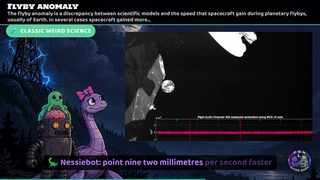
The flyby anomaly is a discrepancy between scientific models and the speed that spacecraft gain during planetary flybys, usually of Earth. In several cases spacecraft gained more speed than predicted, and no convincing explanation has been found. It was first noticed after the Galileo spacecraft's Earth flyby on 8 December 1990, when tracking data showed a velocity increase of 3.92 mm/s. The largest discrepancy noticed is tiny, 13.46 mm/s.
source → -
 2026-11-15Grand Prismatic Spring
The Grand Prismatic Spring is the largest hot spring in Yellowstone and the third largest in the world. Geologists of the 1871 Hayden Survey named it for its coloring, which covers most of the rainbow. The colors come from microbial mats of heat-loving bacteria and archaea around the edges. The mats tend to be orange and red in summer and dark green in winter, depending on the ratio of chlorophyll to carotenoids.
source → -
 2026-11-13Fast radio bursts
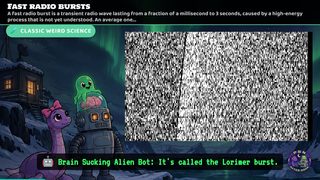
A fast radio burst is a transient radio wave lasting from a fraction of a millisecond to 3 seconds, caused by a high-energy process that is not yet understood. An average one releases as much energy in a millisecond as the Sun does in three days. Duncan Lorimer and his student David Narkevic found the first in 2007 in archival pulsar survey data, and it is called the Lorimer burst. Some repeat, and FRB 180916 seems to pulse every 16.35 days.
source → -
 2026-11-12Great Comet of 1882
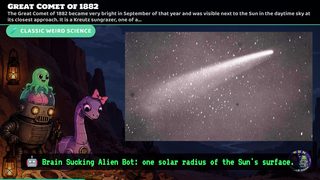
The Great Comet of 1882 became very bright in September of that year and was visible next to the Sun in the daytime sky at its closest approach. It is a Kreutz sungrazer, one of a family of comets that pass within one solar radius of the Sun's surface. It reached its closest approach to Earth on 16 September at 0.99 AU, and some sources say it is the brightest comet ever recorded.
source → -
 2026-11-11Antikythera mechanism
The Antikythera mechanism is an ancient Greek hand-powered model of the Solar System, built in the 2nd century BC and recovered in 1901 from a shipwreck off the island of Antikythera. It is the oldest known analogue computer and could predict astronomical positions and eclipses decades ahead, and track the four-year cycle of the ancient Olympic Games. A politician spotted a gear in it in 1902. It survives as 82 fragments, and the largest gear had 223 teeth.
source → -
 2026-11-07Catatumbo lightning
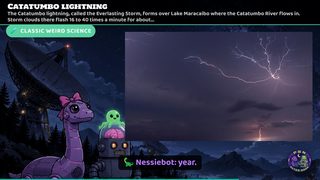
The Catatumbo lightning, called the Everlasting Storm, forms over Lake Maracaibo where the Catatumbo River flows in. Storm clouds there flash 16 to 40 times a minute for about nine hours a night on 140 to 160 nights a year, the highest lightning density in the world, at 250 per square km per year. It stopped from January to March 2010, apparently because of drought, which led some to fear it was gone for good.
source → -
 2026-11-04Kentucky meat shower
On March 3, 1876, for several minutes around noon, what looked like chunks of red meat fell from the sky onto an area of about 90 by 45 meters near Olympia Springs in Bath County, Kentucky. Explanations range from blood rain to vulture ejecta. Reports suggested beef, lamb, deer, bear or horse, but the exact meat was never identified, and the cause remains a subject of speculation.
source → -
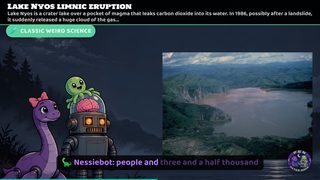 2026-11-02Lake Nyos limnic eruption
Lake Nyos is a crater lake over a pocket of magma that leaks carbon dioxide into its water. In 1986, possibly after a landslide, it suddenly released a huge cloud of the gas, which suffocated 1,746 people and 3,500 livestock in nearby villages. The village of Chah was abandoned. It was the first known large-scale asphyxiation from a natural event, and a degassing tube now siphons deep water to the surface to prevent a repeat.
source → -
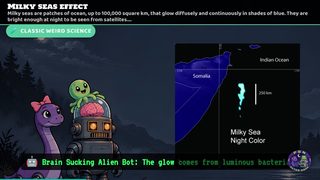 2026-10-29Milky seas effect
Milky seas are patches of ocean, up to 100,000 square km, that glow diffusely and continuously in shades of blue. They are bright enough at night to be seen from satellites. Unlike the flashes of algae, the glow comes from luminous bacteria. Mariners have long reported it, and in 2005 scientists announced the first photographic evidence, followed by a study of a glow that lasted over 40 days.
source → -
 2026-10-28Wow! signal
On August 15, 1977, Ohio State University's Big Ear radio telescope picked up a strong narrowband radio signal that seemed to come from the direction of Sagittarius. Astronomer Jerry Ehman found it days later in the printout, circled the reading 6EQUJ5 and wrote "Wow!" beside it. The signal lasted the full 72 seconds the telescope could watch that spot, and it has never been heard again. No explanation, earthly or otherwise, has been confirmed.
source → -
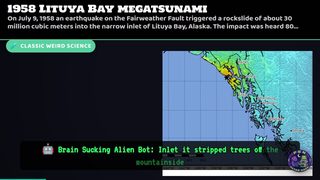 2026-10-231958 Lituya Bay megatsunami
On July 9, 1958 an earthquake on the Fairweather Fault triggered a rockslide of about 30 million cubic meters into the narrow inlet of Lituya Bay, Alaska. The impact was heard 80 km away, and the displaced water made a megatsunami that stripped trees up to 524 meters above the water at the entrance of Gilbert Inlet. It is the largest and most significant megatsunami in modern times and forced a re-evaluation of large-wave events.
source → -
 2026-10-21Blood Falls
Blood Falls is a plume of iron-stained saltwater that flows from the Taylor Glacier onto the ice of West Lake Bonney in the McMurdo Dry Valleys. The water comes from a subglacial pool of unknown size under about 400 meters of ice. Geologist Thomas Griffith Taylor found the red deposit in 1911. Early explorers blamed red algae, but the color was later shown to come from iron oxides.
source →