-
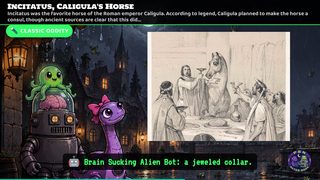 2026-11-28Incitatus, Caligula's Horse
Incitatus was the favorite horse of the Roman emperor Caligula. According to legend, Caligula planned to make the horse a consul, though ancient sources are clear that this did not happen. Suetonius and Cassius Dio report a marble stable, an ivory manger, purple blankets and a jeweled collar. The accuracy of this received history is generally questioned.
source → -
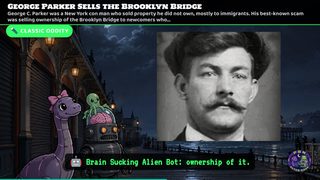 2026-11-27George Parker Sells the Brooklyn Bridge
George C. Parker was a New York con man who sold property he did not own, mostly to immigrants. His best-known scam was selling ownership of the Brooklyn Bridge to newcomers who saw it as one of the first landmarks they reached in the city. After several arrests, his fourth conviction earned him a life sentence in Sing Sing, where he stayed until his death.
source → -
 2026-11-25Lord Timothy Dexter
Timothy Dexter was an eccentric Massachusetts businessman who got rich through marriage and a string of improbably successful investments. According to the traditional story, rivals advised him to ship bed warmers to the West Indies, a tropical place, and the ship's captain sold them as molasses ladles at a profit. His other reported shipments included mittens, coal to Newcastle during a miners' strike, Bibles and stray cats. He wrote a book, A Pickle for the Knowing Ones, notorious for its misspellings.
source → -
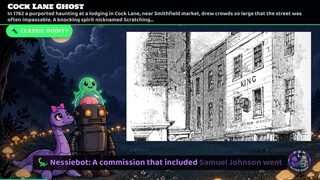 2026-11-24Cock Lane Ghost
In 1762 a purported haunting at a lodging in Cock Lane, near Smithfield market, drew crowds so large that the street was often impassable. A knocking spirit nicknamed Scratching Fanny seemed to claim she had been poisoned with arsenic by her widower. A commission including Samuel Johnson concluded the haunting was a fraud, and further investigation showed that parish clerk Richard Parsons's daughter Elizabeth had perpetrated it under pressure from her father. Parsons was pilloried and sentenced to two years in prison.
source → -
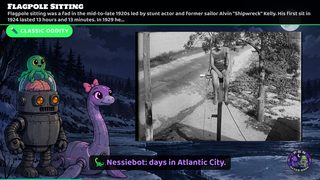 2026-11-23Flagpole Sitting
Flagpole sitting was a fad in the mid-to-late 1920s led by stunt actor and former sailor Alvin "Shipwreck" Kelly. His first sit in 1924 lasted 13 hours and 13 minutes. In 1929 he sat for 49 days in Atlantic City, and in 1930 Bill Penfield sat for 51 days and 20 hours in Iowa until a thunderstorm forced him down. The fad mostly died out after the start of the Great Depression.
source → -
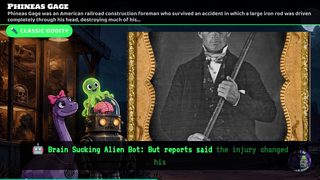 2026-11-20Phineas Gage
Phineas Gage was an American railroad construction foreman who survived an accident in which a large iron rod was driven completely through his head, destroying much of his brain's left frontal lobe. He lived another 12 years, and reports said the injury changed his personality so profoundly that friends saw him as no longer Gage. His case influenced 19th-century discussion about the mind and brain and is a staple of neurology and psychology teaching.
source → -
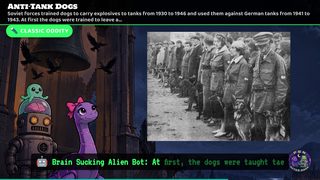 2026-11-18Anti-Tank Dogs
Soviet forces trained dogs to carry explosives to tanks from 1930 to 1946 and used them against German tanks from 1941 to 1943. At first the dogs were trained to leave a timer-detonated bomb and retreat, but this was later replaced by a method that detonated on impact and killed the dog. The Red Army had no dedicated dog trainers in the 1930s, so it used hunters, police and circus trainers.
source → -
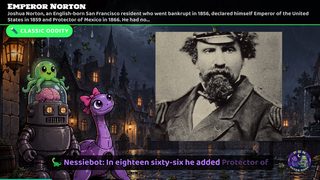 2026-11-17Emperor Norton
Joshua Norton, an English-born San Francisco resident who went bankrupt in 1856, declared himself Emperor of the United States in 1859 and Protector of Mexico in 1866. He had no formal power but kept the roles until his death in 1880, and the city treated him deferentially. He issued his own currency, which some establishments he frequented honored. He proposed building a bridge that eventually opened as the San Francisco-Oakland Bay Bridge in 1936.
source → -
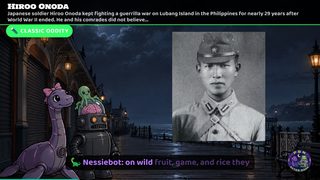 2026-11-16Hiroo Onoda
Japanese soldier Hiroo Onoda kept fighting a guerrilla war on Lubang Island in the Philippines for nearly 29 years after World War II ended. He and his comrades did not believe flyers and letters saying the war was over, and survived on wild fruit, game and stolen rice. He finally surrendered on 10 March 1974, after his former commanding officer flew to the island and formally relieved him of duty.
source → -
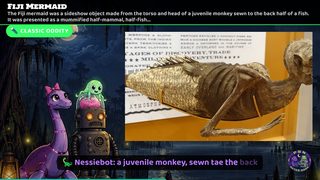 2026-11-13Fiji Mermaid
The Fiji mermaid was a sideshow object made from the torso and head of a juvenile monkey sewn to the back half of a fish. It was presented as a mummified half-mammal, half-fish creature supposedly caught near the Fiji Islands. P. T. Barnum exhibited the original in 1842 in his American Museum in New York, and it then disappeared, probably lost in one of the fires that hit his collections.
source → -
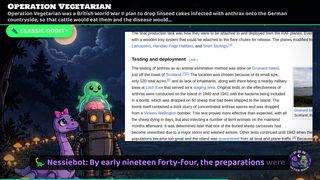 2026-11-12Operation Vegetarian
Operation Vegetarian was a British World War II plan to drop linseed cakes infected with anthrax onto the German countryside, so that cattle would eat them and the disease would spread to people and wipe out the cattle. Research began in 1942 and preparations were complete in early 1944, when the plan was dropped because of Operation Overlord. The cakes were destroyed by incineration in 1945. It was never used.
source → -
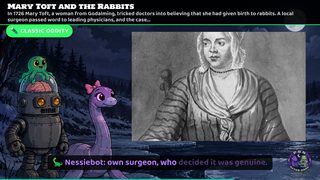 2026-11-11Mary Toft and the Rabbits
In 1726 Mary Toft, a woman from Godalming, tricked doctors into believing that she had given birth to rabbits. A local surgeon passed word to leading physicians, and the case reached the king's own surgeon, who concluded it was genuine. Brought to London and studied closely, she produced no more rabbits and confessed to a hoax staged by her family. She was imprisoned as a fraud, and the affair ruined several surgeons' careers.
source → -
 2026-11-09Project A119
In 1958 the US Air Force developed a top-secret plan to detonate a nuclear bomb on the Moon. The explosion might have been faintly visible to the naked eye on Earth and was meant as a show of force after the Soviets took an early lead in the Space Race. Officials canceled it because the risks outweighed the benefits, and a Moon landing would be a more popular achievement. Its existence was revealed in 2000.
source → -
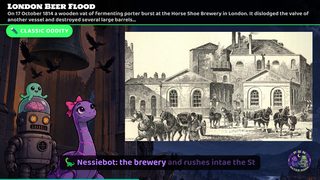 2026-11-08London Beer Flood
On 17 October 1814 a wooden vat of fermenting porter burst at the Horse Shoe Brewery in London. It dislodged the valve of another vessel and destroyed several large barrels, releasing between 128,000 and 323,000 imperial gallons of beer. The wave destroyed the back wall of the brewery and swept into the St Giles slum, killing eight people. The coroner's inquest ruled the deaths accidental, and the brewery got a rebate from the Excise on the lost beer.
source → -
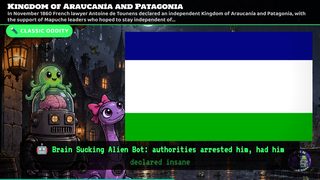 2026-11-07Kingdom of Araucanía and Patagonia
In November 1860 French lawyer Antoine de Tounens declared an independent Kingdom of Araucanía and Patagonia, with the support of Mapuche leaders who hoped to stay independent of Chile and Argentina. Chilean authorities arrested him in January 1862, had him declared insane in Santiago and expelled him to France. He tried three times to return to his kingdom and was captured and deported each time. He died of ill health caused by his long captivity in a Chilean prison.
source → -
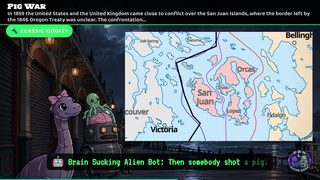 2026-11-06Pig War
In 1859 the United States and the United Kingdom came close to conflict over the San Juan Islands, where the border left by the 1846 Oregon Treaty was unclear. The confrontation was triggered by the shooting of a pig. Despite being called a war, the only casualty on either side was the pig.
source → -
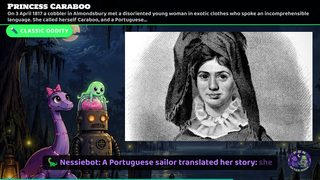 2026-11-05Princess Caraboo
On 3 April 1817 a cobbler in Almondsbury met a disoriented young woman in exotic clothes who spoke an incomprehensible language. She called herself Caraboo, and a Portuguese sailor translated her story, which was that she came from an island kingdom. The woman was really an English impostor named Mary Baker, and she fooled a British town for some months.
source → -
 2026-11-04Operation Moolah
During the Korean War, the US Air Force tried to get a Communist pilot to defect with a fully capable MiG-15 jet. The plan offered $100,000 and political asylum, and was meant to be spread by rumor. Details were published in The Washington Post within days of reaching the Pentagon. No pilot defected before the armistice, and North Korean pilot No Kum-Sok flew his MiG-15 to South Korea on September 21, 1953, unaware of the offer.
source → -
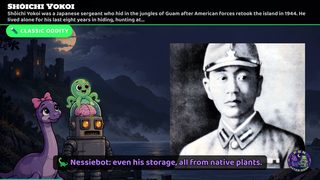 2026-11-03Shōichi Yokoi
Shōichi Yokoi was a Japanese sergeant who hid in the jungles of Guam after American forces retook the island in 1944. He lived alone for his last eight years in hiding, hunting at night and making clothes, bedding and storage from native plants. He was discovered on 24 January 1972, almost 28 years later, as one of the last four Japanese holdouts found after the war.
source → -
 2026-11-01Project Pigeon
During World War II, psychologist B. F. Skinner tried to develop a guided bomb steered by pigeons. One to three birds would sit in front of a screen showing the target and peck at it whenever they saw it, and sensors would steer the weapon by their pecks. The pigeons were trained with food rewards, and one bird pecked more than 10,000 times in 45 minutes.
source → -
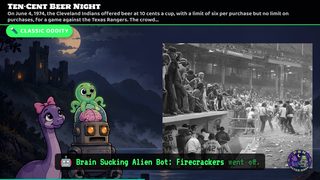 2026-10-31Ten-Cent Beer Night
On June 4, 1974, the Cleveland Indians offered beer at 10 cents a cup, with a limit of six per purchase but no limit on purchases, for a game against the Texas Rangers. The crowd grew rowdy, with firecrackers thrown and fans running onto the field. In the ninth inning fans rushed the field and players had to protect themselves with bats. The umpire declared the game forfeited to Texas.
source → -
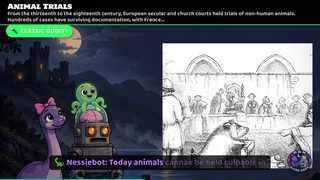 2026-10-30Animal Trials
From the thirteenth to the eighteenth century, European secular and church courts held trials of non-human animals. Hundreds of cases have surviving documentation, with France preserving the most. The records are patchy, so historians cannot say how common the trials really were. Today animals cannot be held culpable in most legal systems because they lack moral agency.
source → -
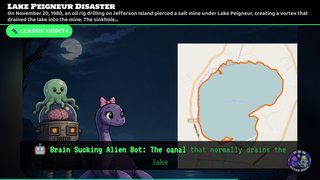 2026-10-28Lake Peigneur Disaster
On November 20, 1980, an oil rig drilling on Jefferson Island pierced a salt mine under Lake Peigneur, creating a vortex that drained the lake into the mine. The sinkhole swallowed the rig, 11 barges, a tugboat and 65 acres of land. The canal that normally drains the lake reversed, which created a 164-foot waterfall for a few days as the lake refilled with salt water. No people died, though three dogs were reported killed, and all 55 mine workers escaped.
source → -
 2026-10-27Exploding Whale
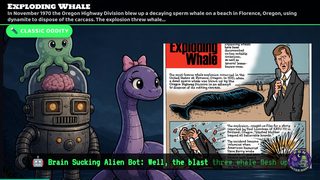
In November 1970 the Oregon Highway Division blew up a decaying sperm whale on a beach in Florence, Oregon, using dynamite to dispose of the carcass. The explosion threw whale flesh up to 800 feet away. The footage circulated widely after humorist Dave Barry wrote about it in 1990.
source → -
 2026-10-25Cottingley Fairies
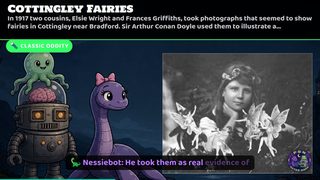
In 1917 two cousins, Elsie Wright and Frances Griffiths, took photographs that seemed to show fairies in Cottingley near Bradford. Sir Arthur Conan Doyle used them to illustrate a Strand Magazine article in 1920 and took them as evidence of the supernatural. In the early 1980s the women admitted the fairies were cardboard cutouts copied from a popular children's book, though Frances maintained the fifth photograph was genuine.
source → -
 2026-10-24Great Sparrow Campaign
Under Mao Zedong's Four Pests campaign, China tried to eliminate sparrows, which farmers said were damaging crops. The campaign was active from 1955 to 1960, with major implementation starting in 1958. At least 200 million sparrows were killed in 1958, and some sources say about 2.11 billion died. Insect populations surged and harvests suffered, and the campaign was one of the causes of the Great Chinese Famine.
source → -
 2026-10-23Goldfish Swallowing
Swallowing live goldfish became a fad among American college students in the late 1930s. A 1963 letter claimed it started when a Harvard freshman did it to win a $10 bet. Universities competed to outdo each other, and an Intercollegiate Goldfish Gulping Association tried to set standards. The last title on record went to a Clark University student who swallowed 89 goldfish. Critics soon formed the Society for the Prevention of Goldfish Eating.
source → -
 2026-10-22Mechanical Turk
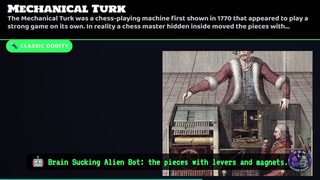
The Mechanical Turk was a chess-playing machine first shown in 1770 that appeared to play a strong game on its own. In reality a chess master hidden inside moved the pieces with levers and magnets. Built by Wolfgang von Kempelen to impress Empress Maria Theresa, it toured for 84 years, beat most opponents including Napoleon and Benjamin Franklin, and was destroyed in a fire in 1854. Its secret was fully explained in print in 1857.
source →